🔐 Overview of Trezor
If you’ve spent any time in the crypto space, chances are you’ve heard of Trezor—and for good reason. It’s not just another hardware wallet brand; it’s one of the original pioneers of crypto self-custody, setting the foundation for how millions of users secure their digital assets today.
Launched in 2014 by SatoshiLabs, Trezor introduced the concept of storing private keys on a dedicated offline device, completely separated from internet-connected systems. At a time when most people relied on exchanges or software wallets, this was a major shift—putting full control back into the hands of users.
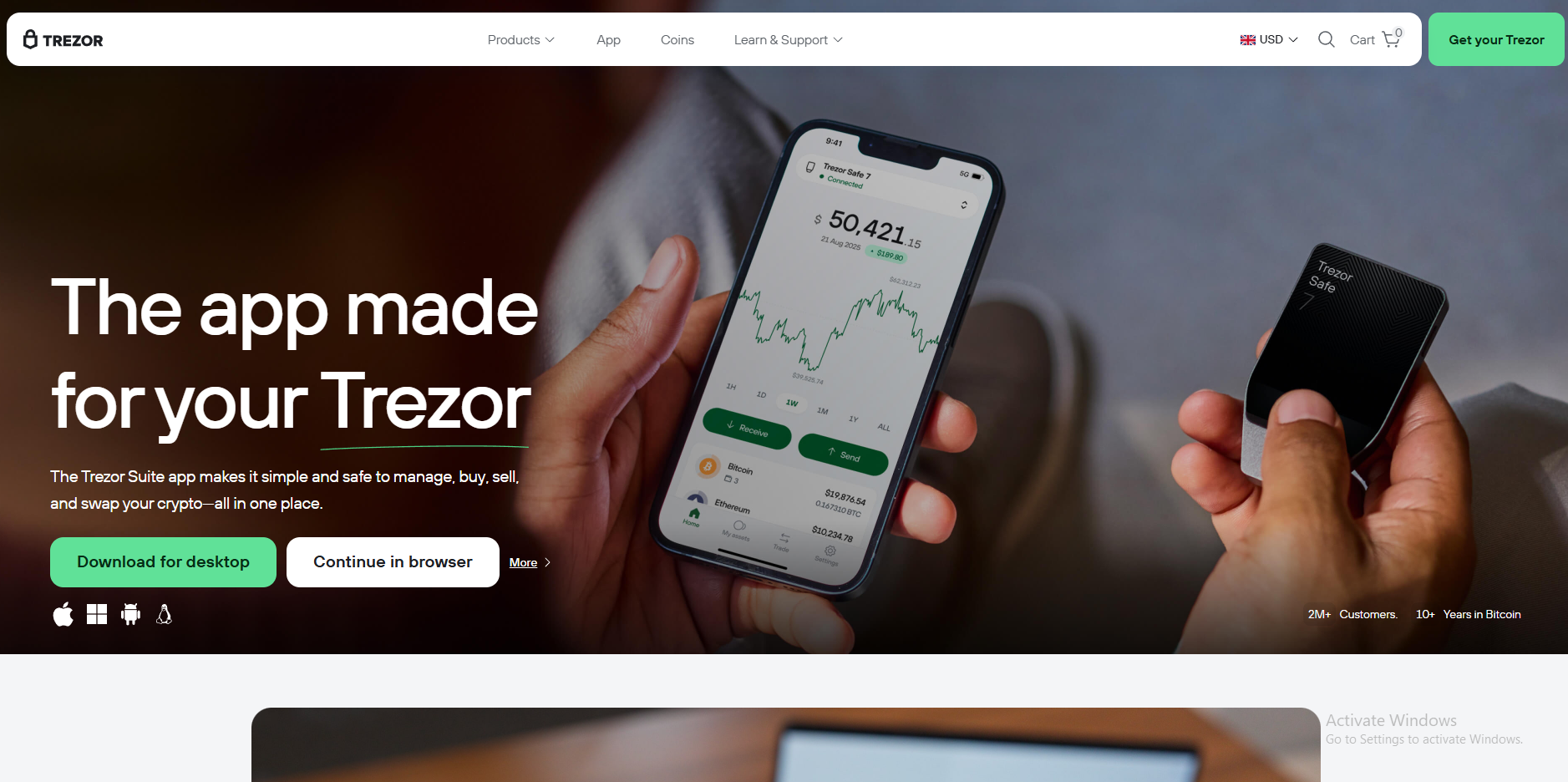
The official platform, Trezor.io, acts as both an educational hub and an online store, where users can explore and purchase devices like:
- Trezor Model One
- Trezor Model T
- Newer-generation wallets such as Safe series devices
But Trezor is more than just hardware—it’s an entire security ecosystem.
At the center of that ecosystem is the Trezor Suite, a desktop and web application that allows users to:
- Manage crypto portfolios
- Send and receive transactions
- Track market performance
- Connect to external wallets and DeFi platforms
The real magic, however, happens behind the scenes. Trezor ensures that your private keys never leave the device. Every transaction must be physically verified on the wallet itself, meaning even if your computer is compromised, your crypto remains protected.
Another defining trait of Trezor is its open-source philosophy. Unlike some competitors, Trezor makes its code publicly available. This means:
- Security researchers can audit it
- Vulnerabilities can be discovered and fixed transparently
- Users don’t have to blindly trust the company
This approach has earned Trezor a reputation for being one of the most transparent and community-trusted solutions in the crypto world.
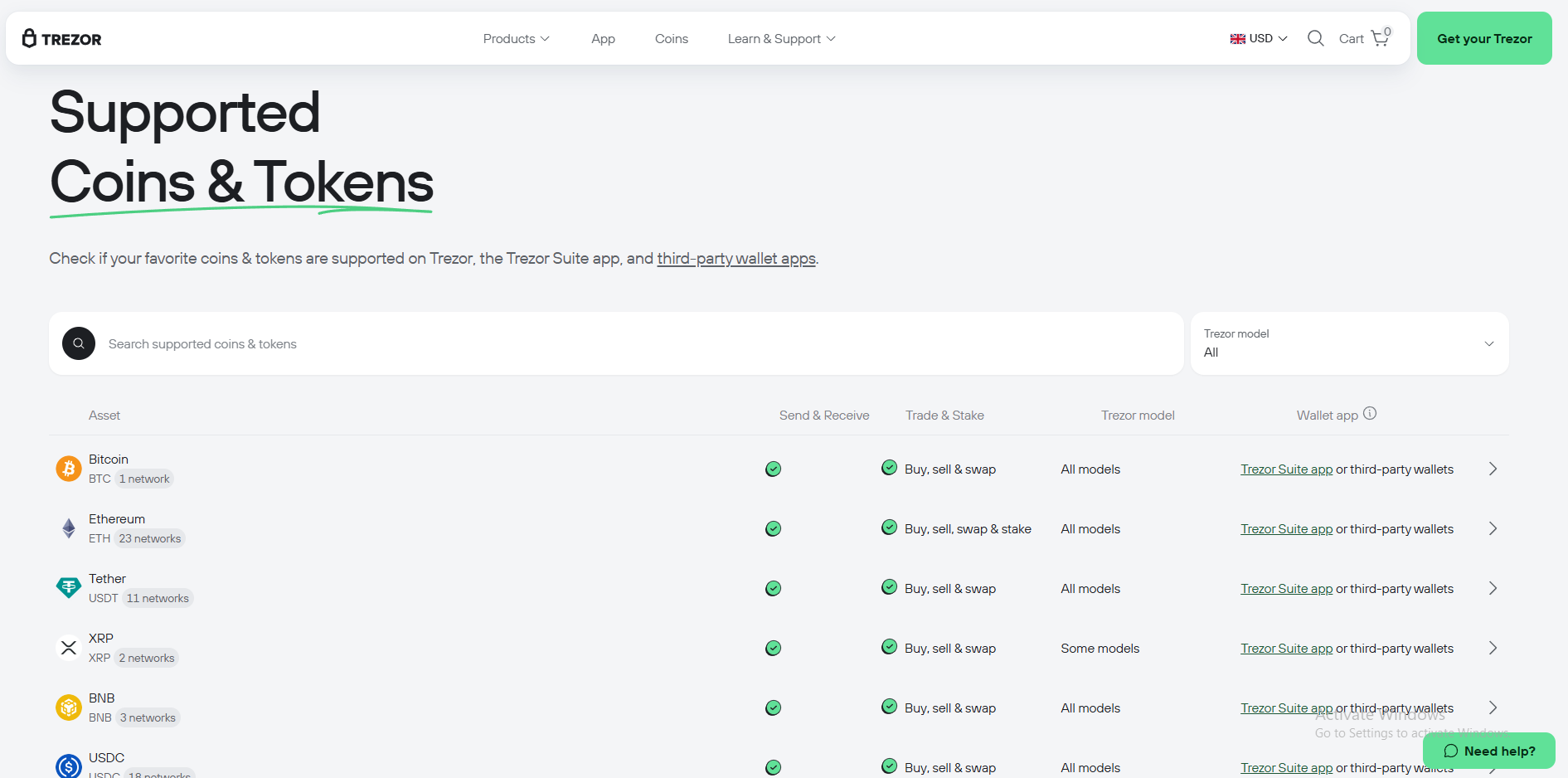
In terms of compatibility, Trezor supports thousands of cryptocurrencies, including major assets like Bitcoin and Ethereum, as well as a wide range of tokens and networks. It also integrates with popular tools like MetaMask, giving users flexibility beyond the native app.
Overall, Trezor.io positions itself not just as a product, but as a philosophy: “Don’t trust, verify—and own your keys.”
✅ Pros of Trezor
What makes Trezor stand out isn’t just what it does—but how it does it.
First and foremost, Trezor delivers exceptional security through simplicity. By isolating private keys in an offline environment and requiring physical confirmation for every transaction, it eliminates most of the common attack vectors in crypto—such as phishing, malware, or exchange hacks. This makes it particularly appealing to long-term investors who prioritize asset protection over convenience.
Another major strength is its commitment to transparency. Because Trezor is fully open-source, its firmware and software can be independently reviewed by developers and security experts worldwide. This creates a level of trust that’s difficult to replicate in closed systems. Instead of asking users to “just trust the brand,” Trezor allows them to verify everything themselves.
The user experience is also more approachable than many expect. Through Trezor Suite, the brand offers a clean, intuitive interface that simplifies complex tasks like managing multiple wallets or tracking portfolio performance. While it still requires a basic understanding of crypto, the onboarding process is structured in a way that helps new users get started without feeling overwhelmed.
Trezor also excels in flexibility and ecosystem compatibility. It doesn’t lock users into a single platform. Instead, it integrates with a wide range of third-party wallets and decentralized applications. This is especially valuable for advanced users who want to explore DeFi, NFTs, or multi-chain interactions without being restricted.
Another often overlooked advantage is long-term reliability. Trezor has been around for over a decade—a lifetime in the crypto industry. This longevity signals not only technical stability but also a consistent commitment to security and innovation.
Finally, there’s the principle of true ownership. With Trezor, your crypto isn’t held by an exchange, a company, or a third party. It’s secured by you—and only you. In a market where platform failures and hacks still occur, this level of control is arguably one of the most valuable features of all.
❌ Cons of Trezor
For all its strengths, Trezor is not without trade-offs—and these are worth understanding in a realistic, no-hype way.
The most frequently discussed limitation is Trezor’s security architecture choice. Unlike competitors such as Ledger, Trezor has historically avoided using a Secure Element chip, opting instead for a fully open, auditable design. While this aligns with its transparency philosophy, it also means that, under highly specific conditions, the device could be more exposed to physical extraction attacks if an attacker has prolonged physical access and advanced technical capability. For everyday users, this risk is extremely low—but for high-value holders, it’s a point worth noting.
Another critical factor is the burden of self-custody. Trezor gives you complete control over your crypto—but that control comes with zero safety net. If you misplace your recovery seed or fail to store it properly, your funds are effectively gone forever. There is no recovery service, no support ticket, and no workaround. This “no compromise” model is exactly what makes Trezor secure—but it can feel unforgiving, especially for newcomers.
From a usability standpoint, Trezor sits in an interesting middle ground. It is simpler than many advanced crypto tools, but it still requires a basic understanding of wallet management, networks, and security practices. Some features—like staking or interacting with decentralized applications—often rely on external integrations rather than being fully native inside the main interface. For users expecting an all-in-one solution, this can feel slightly fragmented.
There are also some hardware and convenience limitations. Most Trezor devices require a wired USB connection, with no Bluetooth support. This makes mobile usage less seamless compared to more modern, wireless competitors. Additionally, while newer models have improved, the overall design still leans toward function over aesthetics, which may not appeal to users looking for a more premium, polished feel.
Finally, like all hardware wallets, Trezor faces the ongoing issue of counterfeit or tampered devices in the market. This isn’t a flaw of the product itself, but it does place responsibility on the buyer to ensure they are purchasing directly from the official source.
💰 Pricing of Trezor
Trezor’s pricing structure reflects its philosophy: accessible entry with scalable upgrades, depending on how much usability and convenience you want.
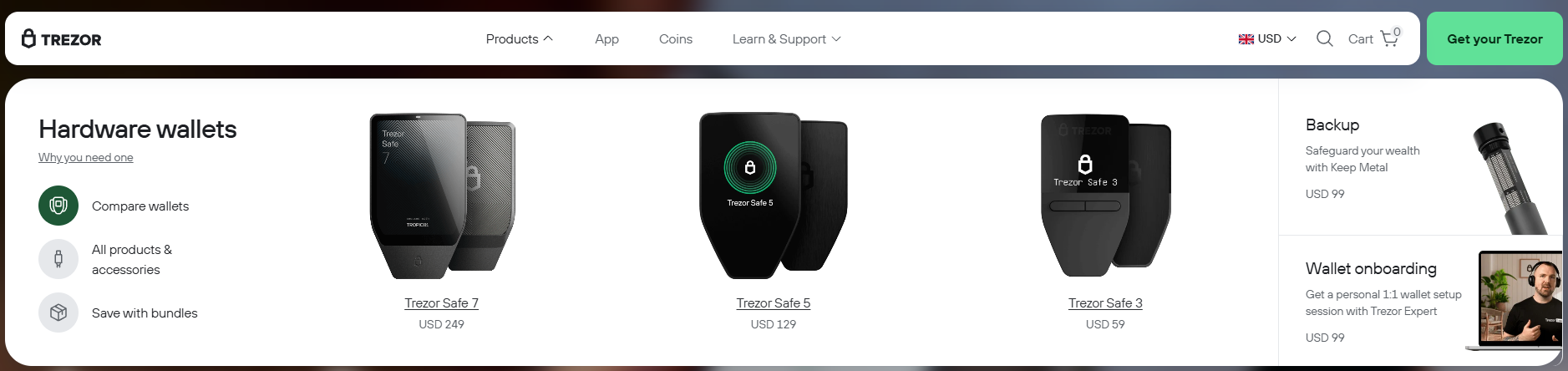
At the entry level, the Trezor Model One sits around the $69 mark, making it one of the most affordable ways to enter the world of hardware wallets. Despite the lower price, it still delivers the core promise of cold storage security, which is more than enough for many users who simply want to protect their assets long-term.
Moving into the newer generation, devices like the Trezor Safe 3 fall roughly in the $79 to $99 range. This tier is where Trezor starts refining its hardware and security approach, offering a more updated experience while keeping the price within reach for most users. For many, this represents the “sweet spot” between cost and capability.
At the higher end, the Trezor Model T and similar premium models typically range from $179 to $220+. These devices introduce features like a touchscreen interface, which may seem minor at first but actually improves security and usability—especially when entering sensitive data directly on the device rather than through a connected computer.
When compared to competitors like Ledger, Trezor tends to be:
- Slightly more affordable at the entry level
- Roughly equivalent in the mid-range
- Competitive but not necessarily cheaper in the premium segment
What stands out is that all Trezor devices share the same core philosophy and security model. Paying more doesn’t necessarily make your crypto “safer”—it simply makes the experience more convenient and user-friendly.
From a long-term perspective, the pricing is relatively easy to justify. A one-time purchase can protect assets for years, without subscription fees or ongoing costs. The real comparison isn’t with other hardware wallets—it’s with the risk of leaving funds on exchanges or hot wallets.
That said, for casual users or those holding very small amounts of crypto, the cost may still feel hard to justify compared to free software wallets.